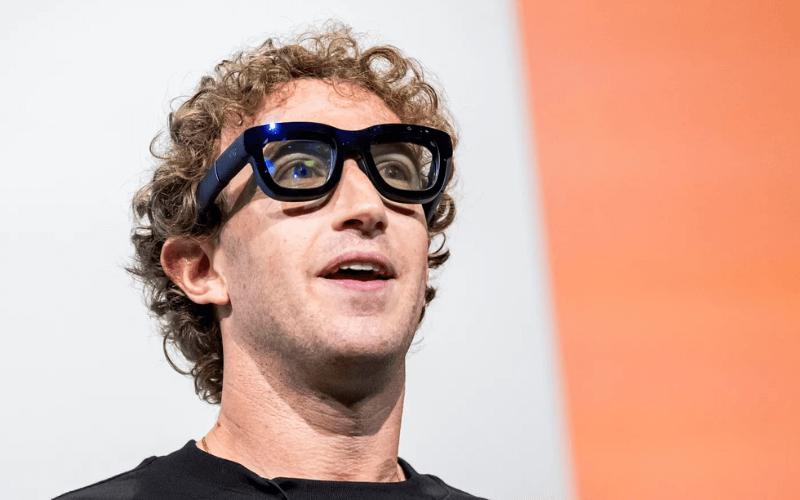
First consumer-ready smart glasses with built-in display and EMG wristband control represent a breakthrough in augmented reality interaction
Meta CEO Mark Zuckerberg today unveiled the company’s most ambitious augmented reality product to date: the $799 Meta Ray-Ban Display glasses featuring the world’s first consumer-ready smart glasses with a built-in display and revolutionary electromyography (EMG) wristband controller that responds to subtle hand gestures and muscle signals.
The Ray-Ban Display glasses, internally codenamed “Hypernova,” represent a quantum leap in AR computing by combining a translucent heads-up display in the right lens with the Meta Neural Band — an EMG wristband that enables users to control digital interfaces through micro-gestures, including typing on virtual keyboards projected onto any surface.
At Meta Connect 2025, Zuckerberg demonstrated capabilities that seemed like science fiction just years ago, showing users responding to text messages, receiving navigation directions, and interacting with AI assistants through subtle finger movements detected by the Neural Band’s advanced electromyography sensors.
Table of Contents
Revolutionary Neural Band: Mind-to-Machine Interface
The Meta Neural Band represents perhaps the most significant breakthrough in human-computer interaction since the touchscreen, utilizing electromyography technology to detect electrical signals generated by muscle contractions and translate them into precise digital commands.
The EMG wristband picks up on subtle hand gestures and muscle signals that are often imperceptible to observers, enabling what Meta calls “invisible interaction” with digital content. Users can scroll, tap, swipe, and even type without touching physical surfaces, creating an entirely new paradigm for mobile computing interaction.
The demonstration videos show users typing on virtual keyboards that appear to float in their field of vision, with the Neural Band translating finger movements into accurate text input regardless of the surface they’re “typing” on. This capability essentially transforms any environment into a potential workspace, eliminating the need for physical keyboards or touchscreens for basic computing tasks.
The electromyography sensors are sensitive enough to detect micro-movements and muscle intentions, allowing for gesture recognition that works even when hands are at rest or movements are barely visible. This precision enables fine-grained control over digital interfaces while maintaining social acceptability in public environments.
Display Innovation: Private AR in Everyday Eyewear
The Ray-Ban Display glasses feature a translucent heads-up display integrated into the right lens, providing what Meta describes as a “private display” that shows information only to the wearer while remaining invisible to others. This addresses one of the fundamental challenges in AR glasses development: creating useful augmented reality without the social awkwardness of obvious digital overlays.
The display technology can show and allow responses to text chats, AI prompts, navigation directions, and video calls, essentially creating a personal heads-up display for smartphone functionality without requiring users to look down at their phones constantly.
The visual interface has been optimized for readability across various lighting conditions while maintaining the classic Ray-Ban aesthetic that has made the brand’s smart glasses socially acceptable. Unlike previous AR glasses that looked obviously technological, the Display glasses maintain the appearance of traditional eyewear while hiding sophisticated display technology.
The positioning in the right lens provides optimal viewing angles without obstructing natural vision, allowing users to access digital information while remaining fully aware of their physical environment. This balance addresses safety concerns that have limited adoption of previous AR devices.
Technical Achievement: Miniaturization and Integration
Housing a functional display, camera, audio system, and wireless connectivity within the confines of traditional eyeglass frames represents a remarkable engineering achievement that required breakthrough miniaturization and thermal management technologies.
The glasses maintain the Ray-Ban aesthetic while incorporating advanced computing capabilities including AI processing, voice recognition, camera functionality, and wireless communication systems. The integration challenge involved balancing functionality, power consumption, heat generation, and weight distribution within the strict constraints of wearable eyewear.
Battery life and thermal management represent critical challenges for AR glasses, and Meta’s solution appears to leverage distributed processing between the glasses and connected devices to optimize power consumption while maintaining responsive performance.
The camera functionality continues Meta’s smart glasses strategy, providing visual AI capabilities and video calling features while maintaining privacy considerations that have evolved since the initial Ray-Ban Stories launch.
Pricing Strategy and Market Positioning
At $799 including the Meta Neural Band, the Ray-Ban Display glasses represent aggressive pricing for cutting-edge AR technology, positioning the product as premium consumer electronics rather than experimental tech gadgets.
The price point includes both the glasses and the essential Neural Band controller, providing a complete AR computing system for less than many flagship smartphones. This pricing strategy suggests Meta’s confidence in manufacturing at scale and commitment to mainstream AR adoption rather than niche early adopter markets.
Compared to previous AR glasses attempts from other manufacturers that have cost thousands of dollars while offering limited functionality, Meta’s pricing makes advanced AR technology accessible to broader consumer segments for the first time.
The inclusion of the Neural Band in the base price acknowledges that the wristband controller is essential for the full experience, avoiding the fragmented ecosystem problems that have plagued other emerging technology categories.
AI Integration and Smart Assistance
The Ray-Ban Display glasses leverage Meta’s advanced AI capabilities to provide intelligent assistance through the built-in display and Neural Band interaction system. Users can access AI-powered features including real-time translation, visual search, and contextual information about their environment.
The AI integration extends beyond basic voice commands to include visual understanding and contextual awareness, enabling the glasses to provide relevant information based on what users are looking at or their current location and activity.
Voice interaction capabilities have been enhanced for the AR environment, allowing users to communicate with Meta AI through natural speech while receiving responses through the private display rather than audio output that might disturb others or compromise privacy.
The combination of visual AI, voice recognition, and gesture control creates a multimodal interaction system that adapts to different social contexts and user preferences, making AR assistance more practical for everyday use.
User Experience and Social Acceptance
Meta has prioritized social acceptance in the Ray-Ban Display design, learning from the mixed reception of previous smart glasses that looked obviously technological. The Display glasses maintain traditional eyewear aesthetics while providing advanced functionality.
The “invisible interaction” enabled by the Neural Band addresses social concerns about obvious gesture control that might appear strange to observers. Users can control their digital experience through subtle movements that don’t draw attention or appear antisocial.
The private display concept ensures that digital content remains personal rather than creating the social barriers that have limited adoption of previous AR devices. Other people cannot see the user’s digital interactions, maintaining normal social eye contact and engagement.
The glasses support prescription lenses and various Ray-Ban frame styles, ensuring that users don’t have to compromise their personal style or vision correction needs to access AR functionality.
Development Timeline and Market Entry
The Ray-Ban Display glasses represent years of development building on Meta’s previous smart glasses partnerships with Ray-Ban and the company’s broader AR research initiatives. The product evolution from the original Ray-Ban Stories demonstrates iterative improvement toward practical AR computing.
The Neural Band technology builds on Meta’s acquisition of CTRL-labs in 2019 and years of research into brain-computer interfaces and electromyography applications for consumer electronics. This long-term investment is now producing commercially viable products.
Market availability details remain limited, but Meta’s announcement suggests the company is moving beyond prototype demonstrations toward actual consumer product launches, though specific release dates and markets have not been confirmed.
The timing aligns with broader industry momentum toward AR glasses, with Apple, Google, and other major tech companies pursuing similar technologies, suggesting the market may be approaching an inflection point for consumer AR adoption.
Technical Challenges and Limitations
Despite the impressive demonstration, the Ray-Ban Display glasses face significant technical challenges that may limit initial functionality and user experience. The live demonstration included technical difficulties, with the glasses failing to receive a phone call during the Connect 2025 presentation.
Battery life remains a critical constraint for AR glasses, and the power requirements for display technology, AI processing, and wireless communication may limit practical usage periods. Extended AR use has historically required frequent charging that can interrupt workflows.
The accuracy and reliability of EMG gesture recognition in varied real-world conditions remains unproven at scale. Environmental factors, user movement, and individual physiological differences may affect the Neural Band’s ability to consistently interpret intended gestures.
Social and privacy concerns persist around camera-enabled glasses, particularly in environments where recording may be prohibited or considered inappropriate. Meta will need to address these concerns through clear visual indicators and user education.
Competitive Landscape and Industry Impact
The Ray-Ban Display launch intensifies competition in the emerging AR glasses market, with major technology companies racing to deliver practical consumer AR devices. Meta’s early entry with a complete display and control system could establish important market advantages.
Apple’s rumored AR glasses development and Google’s renewed interest in smart eyewear suggest significant industry investment in similar technologies. Meta’s first-mover advantage with consumer-ready AR display glasses could influence the competitive dynamics and user expectations for the category.
The Neural Band controller represents a potential differentiator that competitors may need to match or exceed, creating opportunities for Meta to establish patents and technical leadership in gesture-based AR interaction.
Traditional eyewear companies face potential disruption as technology companies integrate advanced capabilities into fashionable frames, potentially reshaping the optical industry and consumer expectations for eyewear functionality.
Privacy and Regulatory Considerations
Smart glasses with cameras and always-on connectivity raise significant privacy concerns that Meta must address through technical design and policy frameworks. The company’s previous experiences with privacy controversies add scrutiny to new products that collect visual and biometric data.
The Neural Band’s collection of electromyography data represents a new category of biometric information that may require specific privacy protections and user consent frameworks. Regulators may need to develop new guidelines for EMG data collection and use.
Visual recording capabilities in smart glasses continue to face restrictions in various environments and jurisdictions, potentially limiting where users can comfortably wear and use the devices without legal or social complications.
Meta’s approach to data collection, processing, and sharing will significantly influence consumer acceptance and regulatory approval for the Ray-Ban Display glasses in various markets worldwide.
Future Implications and AR Evolution
The successful launch of display-enabled smart glasses with intuitive gesture control could accelerate broader AR adoption and influence the development of AR computing ecosystems. The combination of private displays and invisible interaction addresses major barriers that have limited previous AR devices.
The Neural Band technology has applications beyond smart glasses, potentially enabling gesture control for various computing devices and interfaces. This could establish Meta as a leader in next-generation human-computer interaction technologies.
Success with consumer AR glasses could provide Meta with valuable user data and experience that informs the development of more advanced AR and VR products, including the company’s metaverse initiatives and future computing platforms.
The Ray-Ban Display glasses may represent an intermediate step toward more advanced AR devices that provide full environmental overlay and immersive computing experiences, helping users adapt to AR interfaces while technology continues advancing.
Market Reception and Consumer Adoption
Early market reception will be crucial for determining whether Meta has successfully bridged the gap between experimental AR technology and practical consumer products. Previous smart glasses have struggled with limited functionality and social acceptance challenges.
The $799 price point targets mainstream consumers rather than early adopters, suggesting Meta’s confidence in broad market appeal. However, consumer willingness to adopt new interaction paradigms and wear camera-enabled glasses remains uncertain.
The Ray-Ban branding and familiar form factor may help overcome adoption barriers that have limited previous AR devices, leveraging established fashion credibility and consumer trust in the eyewear brand.
Success or failure of the Ray-Ban Display glasses could significantly influence investor and industry confidence in consumer AR markets, potentially accelerating or slowing broader AR development efforts.
Conclusion: AR Computing’s Consumer Breakthrough
Meta’s Ray-Ban Display glasses with Neural Band controller represent the most practical consumer AR computing system yet developed, combining useful functionality with social acceptability and mainstream pricing. The integration of private displays with invisible gesture control addresses fundamental barriers that have limited AR adoption.
While technical challenges and market uncertainties remain, the product demonstrates significant progress toward Meta’s vision of AR as the next computing platform. The combination of familiar eyewear design, advanced display technology, and innovative interaction methods creates a compelling foundation for mainstream AR adoption.
The success of the Ray-Ban Display glasses could establish Meta as the early leader in consumer AR computing while accelerating industry development and consumer acceptance of augmented reality as an everyday technology rather than experimental gadget.
Whether the product delivers on its ambitious promises will determine not just Meta’s AR strategy but potentially the timeline for broader consumer adoption of augmented reality computing technologies.
Leave a Reply